Structured decorative plaster, Venetian plaster and microcement all solve the same question — how a wall becomes something other than a flat painted surface — but at very different prices and with very different demands on the wall beneath. This article covers when each one earns its cost, and what it actually costs.
The starting point: every wall begins as flat plaster
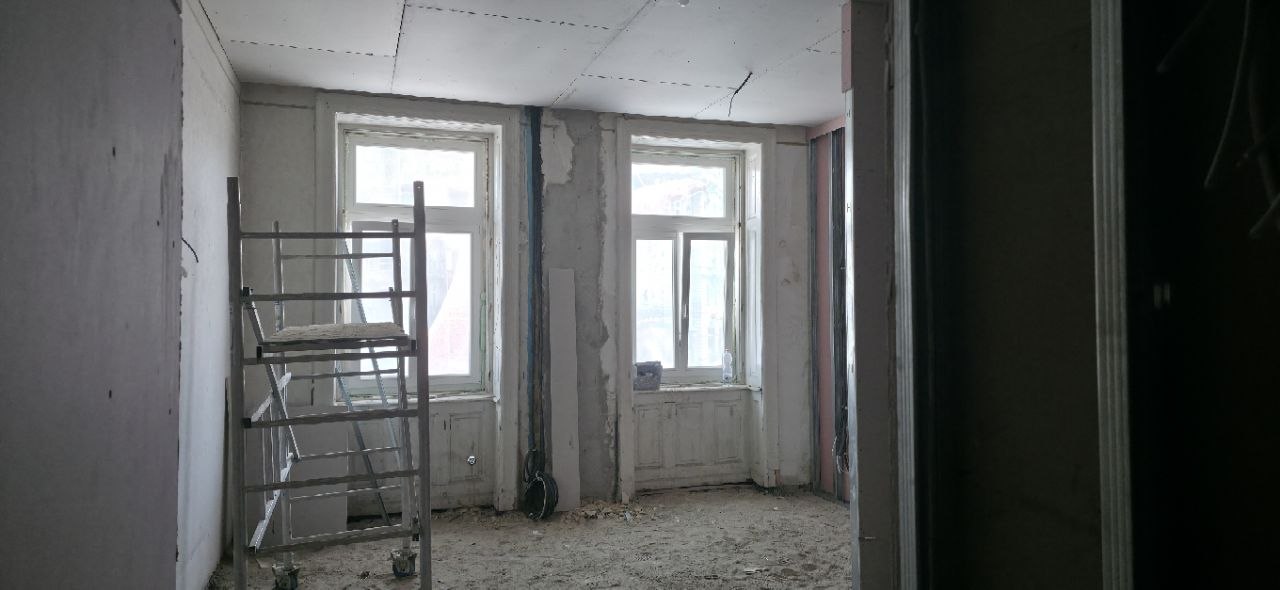
Before deciding on any decorative coating, it helps to know where every wall starts: priming, a filler base coat, a two-layer finish coat, sanding. That is the flat, paint-ready surface — we covered this in detail in our article on what a quote includes.
Three directions, three prices
| Coating | Where it fits |
|---|---|
| Structured decorative plaster | Larger areas needing texture on a limited budget |
| Venetian plaster | Representative spaces, an accent wall, where light and depth matter |
| Microcement (wall or floor) | A seamless, joint-free surface — bathroom, kitchen, industrial-feel spaces |
The benchmark is ordinary paint with full preparation. Structured plaster is somewhat more expensive than that, Venetian plaster two to three times as much, and microcement four to five times as much.
Structured decorative plaster: the entry level
Structured plaster costs less than most people expect for a "decorative" coating. It adds texture, hides minor plane deviations, and stays affordable even over a larger area (a hallway, a corridor, one living-room wall). In exchange, the evenness of the texture depends entirely on the applicator's hand — worth checking on the contractor's previous work before deciding.
Venetian plaster: where the light does the work
Venetian plaster is applied in multiple layers with a hand trowel, then polished, producing depth and a play of light — which is what its rate reflects. It is not by accident that we almost always limit it to a single accent wall: a full room in Venetian plaster rarely earns its price, but one well-lit wall usually does.
Worth knowing: Venetian plaster scratches and marks more easily than painted wall, and repairing it also takes skill — not a DIY-friendly surface in a high-traffic zone.
Microcement: the most expensive because it does the most
On a wall or floor surface this is the highest item on the list, and for good reason. Microcement is joint-free, water-resistant, and gives a continuous surface across the wall-to-floor transition, a real advantage over conventional tile in a wet room (bathroom, shower).
Several stages sit behind the price: priming, multiple coats of microcement, sanding between each coat, then a sealer. The quality of the result depends entirely on the precision of the application — this is the coating where choosing the cheapest quote is least advisable.
Which one to choose
Limited budget, large area: structured plaster.
One representative wall where light matters: Venetian plaster.
A wet room or a seamless, industrial feel: microcement.
Unsure, or budget is tight: a well-prepared, painted wall — not a compromise, but a proven solution in its own right.
Whichever you choose, the quality of the base surface — covered at the start of this article — matters just as much. Even the most expensive coating looks uneven over a flawed base.
Frequently asked questions
Because it involves several stages — priming, multiple coats, sanding between coats, a sealer — and gives a joint-free, water-resistant surface, which is a functional advantage in a wet room, not only an aesthetic one.
One well-lit accent wall is almost always the better value than a full room. The light and depth effect shows on a single wall too, while the cost drops to a quarter.
Yes, but it takes skill — not a DIY repair. How visible the repaired patch is depends on the size of the damage and the age of the surface.
Drying between coats is 24 hours per coat; reaching full load capacity takes 7–10 days. That needs to be built into the renovation schedule.
Yes, that is a common solution in a bathroom: floor and shower wall in microcement, the rest painted. It keeps the joint-free shower while cutting the cost significantly.