A façade solves two entirely different problems at once: how much heat the house loses, and what it looks like from outside. The two cannot really be separated — insulation thickness and the type of decorative render applied over it together shape the final result. This article follows our project at Balaton through the process, with real prices.
What is found under the insulation
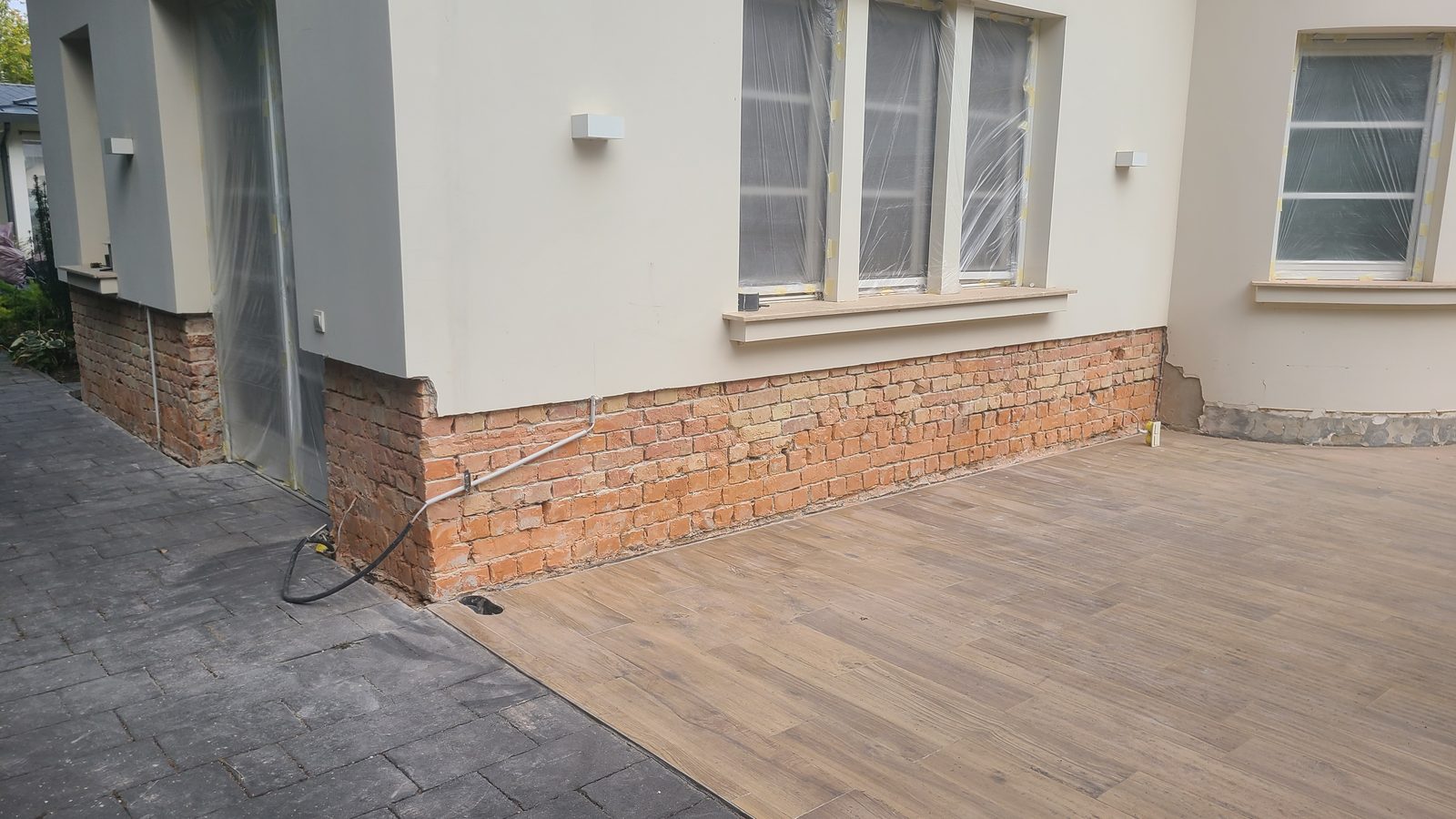
In older or partially insulated houses, part of the façade is often bare brick — typically the base course, where insulation was either not required earlier or was never completed. Before anything goes over it, that surface has to be prepared too: cleaning, repointing where needed, then the same layer structure as the rest of the wall.
The layer structure and its price
| Stage | Unit |
|---|---|
| Bonding + dowelling the insulation board | m² |
| Reinforcement mesh + base render coat | m² |
| Façade priming | m² |
| Decorative render, fine texture ("Bárányka") | m² |
| Decorative render, scratch texture ("Kratzputz") | m² |
| Profiles, junctions, corners | lm |
| Turnkey package (insulation + mesh + decor) | m² |
Adding up the itemised rates comes to more than the turnkey package — that is not an accident: the package price assumes one crew runs all four stages through, without interruption, off the same scaffolding. Ordered separately (different timing, different crew), each stage carries its own setup and protective-sheeting cost, which is why doing it as one job works out better.
"Bárányka" or "Kratzputz" — what is the difference
Both are structured, mineral- or silicone-based decorative renders; the difference is in grain size and application technique. "Bárányka" gives a finer, more even grained surface; "Kratzputz" a coarser, scratched texture — the latter shows dirt less visibly, which is why it is more common on street-facing, higher-traffic façades.
Both come in the same range of colours; the small price difference between them comes from the difference in application labour, not from a more expensive material.
Why the façade cannot be split up however you like
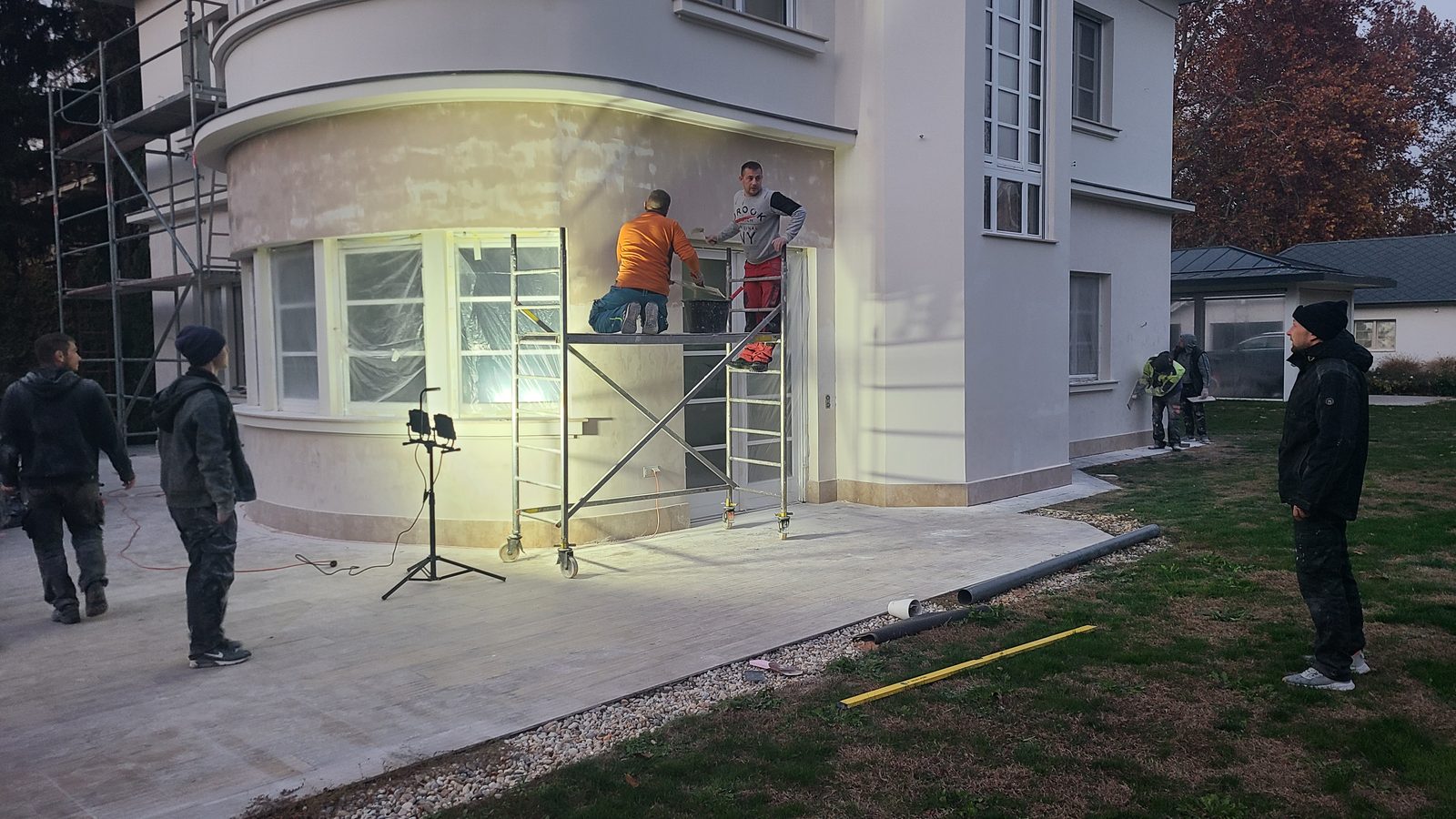
Applying render and the decor layer needs a continuity boundary — one wall plane cannot be finished on two different days by two different crews without the seam showing. That is why we always break a façade project into wall-sized units, and do not strike the scaffolding on a unit until it is finished.
Weather has a say too: applying the decor layer is risky both below 5°C and in direct sun — setting too fast or too slow can crack it. That is why the evening work under artificial light on this project was not a matter of convenience but of avoiding the heat of the day.
Who needs façade insulation: a house or a building association
Façade insulation typically comes up for two kinds of client: a detached-house owner, motivated by running costs and appearance at once, and a building association, where the façade is common property. In the latter case the decision has to go through the general assembly, and often carries a permit procedure too, for a protected building or a protected townscape area.
If the façade is already in good structural condition but the colour or texture has dated, the decor layer alone can be refreshed without the full insulation package — in that case only priming and decorative render are relevant, at a significantly lower total cost.
Frequently asked questions
Because in the turnkey package one crew runs all four stages on one set of scaffolding without a break. Ordered separately, each stage carries its own setup and protection cost, which accounts for the difference.
A façade of around 150 m², with good weather, typically takes 3–4 weeks from bonding the insulation to a finished decorative layer. In bad weather (frost, prolonged rain) it can stretch out, because the layers' setting time cannot be rushed.
For a standalone detached house, generally not, but yes for a protected building or a protected townscape area. For a building association, general assembly approval is always required, since the façade is common property.
Spring through autumn, when the temperature stays reliably above 5°C. In summer, because of direct sun, we often work early morning or evening so the decorative layer sets evenly.
Yes, if the existing insulation and base surface are in good condition. In that case only priming and decorative render are relevant, at a significantly lower total cost.